Photo courtesy of Kristina Styles
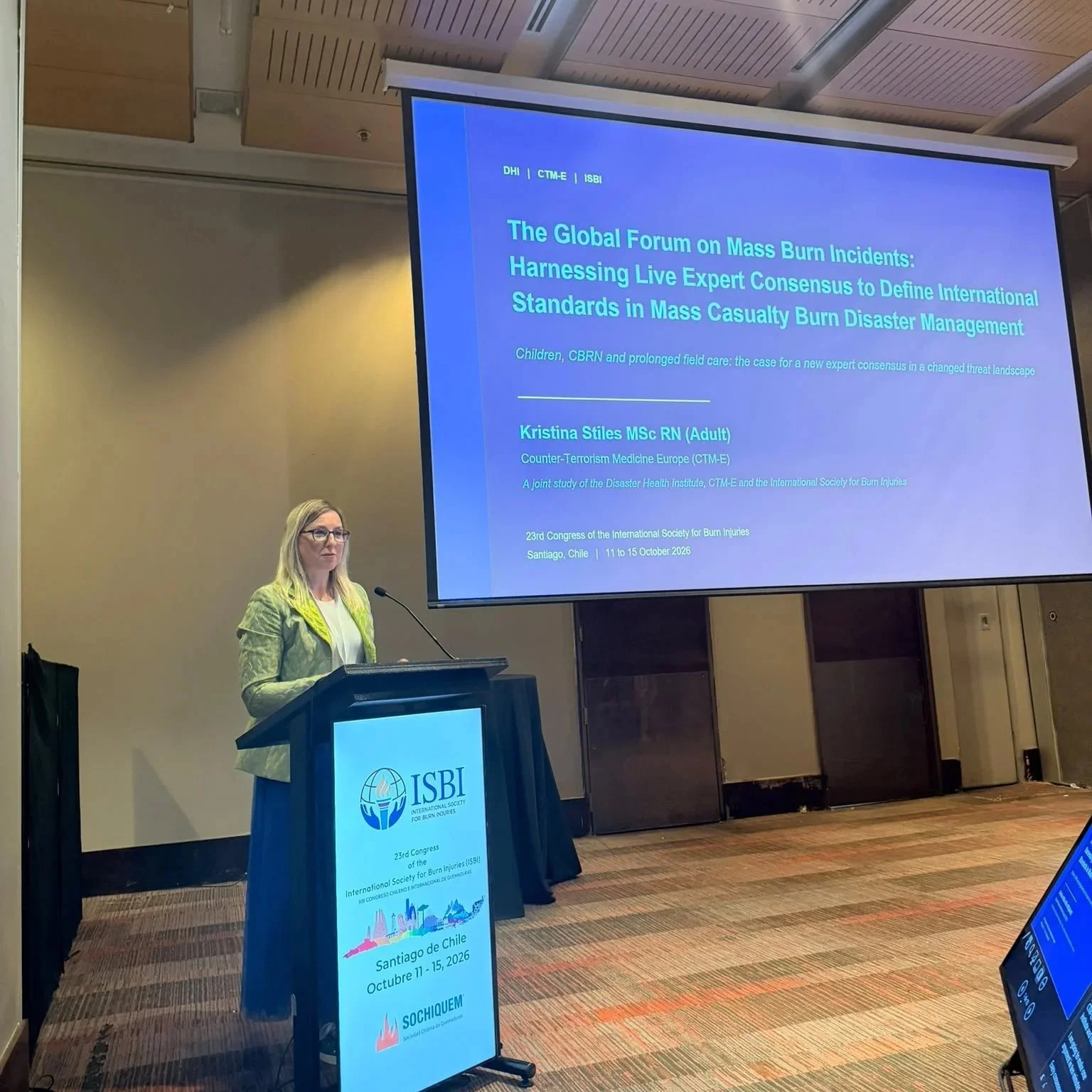
Kristina Styles presents collaborative research project at the International Society for Burn Injuries (ISBI) Congress in Santiago, Chile.
Mass-casualty burn disasters—whether triggered by terrorist attacks, industrial explosions, or major transportation incidents—place an unprecedented strain on specialised healthcare resources. Managing these high-stress events requires clear, unified protocols across pre-hospital, emergency medicine, and specialised burn care teams.
To address this critical gap, the featured presentation detailed a major joint initiative between Counter-Terrorism Medicine Europe (CTM-E), the International Society for Burn Injuries (ISBI), and the Disaster Health Institute (DHI).
The research formalises a statement of strategic collaboration among the three institutions, establishing a methodological roadmap to harness global expert consensus. By integrating cross-disciplinary knowledge from burn care specialists, disaster responders, and counter-terrorism medicine professionals, the initiative seeks to define actionable, standardised international protocols for mass-casualty burn incidents.
Kristina Styles highlighted the need to move from fragmented local strategies to globally recognised standards of practice. Establishing structured triage, surge-capacity models, and resource-allocation thresholds ensures clinical teams worldwide can deliver the highest possible standard of care under extreme constraints.
Current security realities are driving research into burn management during mass-casualty incidents, including the CRN (chemical, radiological, nuclear) component and related risk factors. Fire is being weaponised as a tactic in both terrorist operations, hybrid warfare and even conflict. This approach can easily inflict severe injuries in large numbers, overwhelming specialised medical capacity.
Recent attacks show that both state and non-state actors deliberately target critical national infrastructure, energy terminals, and high-density transportation hubs in urban, rural, and maritime settings. Given the operational capabilities of each environment, structural fires, blasts, and toxic inhalation injuries converge to create catastrophic patient surges that rapidly outstrip regional burn resources.
CTM-E remains dedicated to promoting institutional partnerships that advance operational preparedness and disaster resilience. Further updates and outputs from this ongoing consensus process will be shared in upcoming publications.