Mass Casualty Surgical Preparedness and Response Research Division (MCSPR)
The Mass Casualty Surgical Preparedness and Response Research Division (MCSPR) is a specialised research division (RD) within Counter-Terrorism Medicine Europe.
Division Overview
Injuries requiring surgical intervention are a common feature of mass casualty incidents, particularly from the perspective of conflicts and counter terrorism. Surgical Intervention is a rate-limiting step for survivability in penetrating and blast injuries, yet it is rarely the primary unit of analysis. Despite its importance, existing evidence is scattered across single-event reports, military experience and heterogeneous definitions, which makes it hard to translate into hospital protocols.
The research division therefore aims to be the first in this field to generate a coherent and publication-ready body of evidence that identifies gaps and standardises concepts, which will hopefully inform practical surgical preparedness guidelines for terrorist and conflict-related MCIs in the future.
This will be done through a coordinated effort across the division as a whole, with the idea of targeted research attacking three major themes. The focus here is to extend the spotlight on surgical interventions, awareness and education for non-surgical roles in times of crisis.
Further aims of the research division will be to promote monthly webinar lectures by invited guests from within and outside the organisation, free discussion sessions, and a new section of literature related to surgical response.
Core objectives
Forward Prehospital Surgical Care
Surgical capability close to the point of injury. We examine the role of forward surgical teams, surgical education and procedures for paramedics and non-surgical specialities, and damage-control surgical care in austere or contested settings, including the interfaces with evacuation.
Surgical Mobilisation in Hospital
Performance before casualty arrival. Investigation into the department's mobilisation and readiness, theatre and ICU capacity, staffing models, blood and equipment readiness, and the use of drills and simulation to test and improve preparedness.
Surgical Triage, Antimicrobial Resistance and Resource Allocation in MCIs
Performance after casualty arrival. This pillar covers hospital-level (secondary) surgical triage, thresholds between damage-control and definitive surgery under resource constraint, theatre throughput, allocation of blood products and consumables, and surgical team fatigue and rotation and the problem of antimicrobial resistance. It also addresses complex scenarios (secondary attacks, multi-site incidents, CBRN contamination, and blast-specific injury patterns) and outcome measurement, including the absence of a standard surgical reporting template (an Utstein-style framework for MCI surgery) and follow-up of reconstruction, reoperation, and long-term outcomes.
Strategic Objectives
Division Structure
Evidence-based research
Map and synthesise existing evidence within each pillar through scoping and systematic reviews, and produce a coordinated series of five to eight studies each year, with at least one from every pillar. Studies are targeted for publication and conference presentation, with a clear end objective.
Standardisation of concepts
Identify and prioritise surgical knowledge gaps through structured methods such as expert consensus and Delphi, and propose standardised definitions, metrics, and reporting frameworks for surgical preparedness and response.
Translation into practice
Translating findings into practical guidance, training content, and further primary research that hospitals, surgical departments, and planners can apply.
Collaboration and capacity building
Building a collaborative network and author pipeline, improving interoperability among current CTM-E members, increasing CTM-E membership, and providing a learning space and publication opportunities for early-career researchers.
Join the Research Division
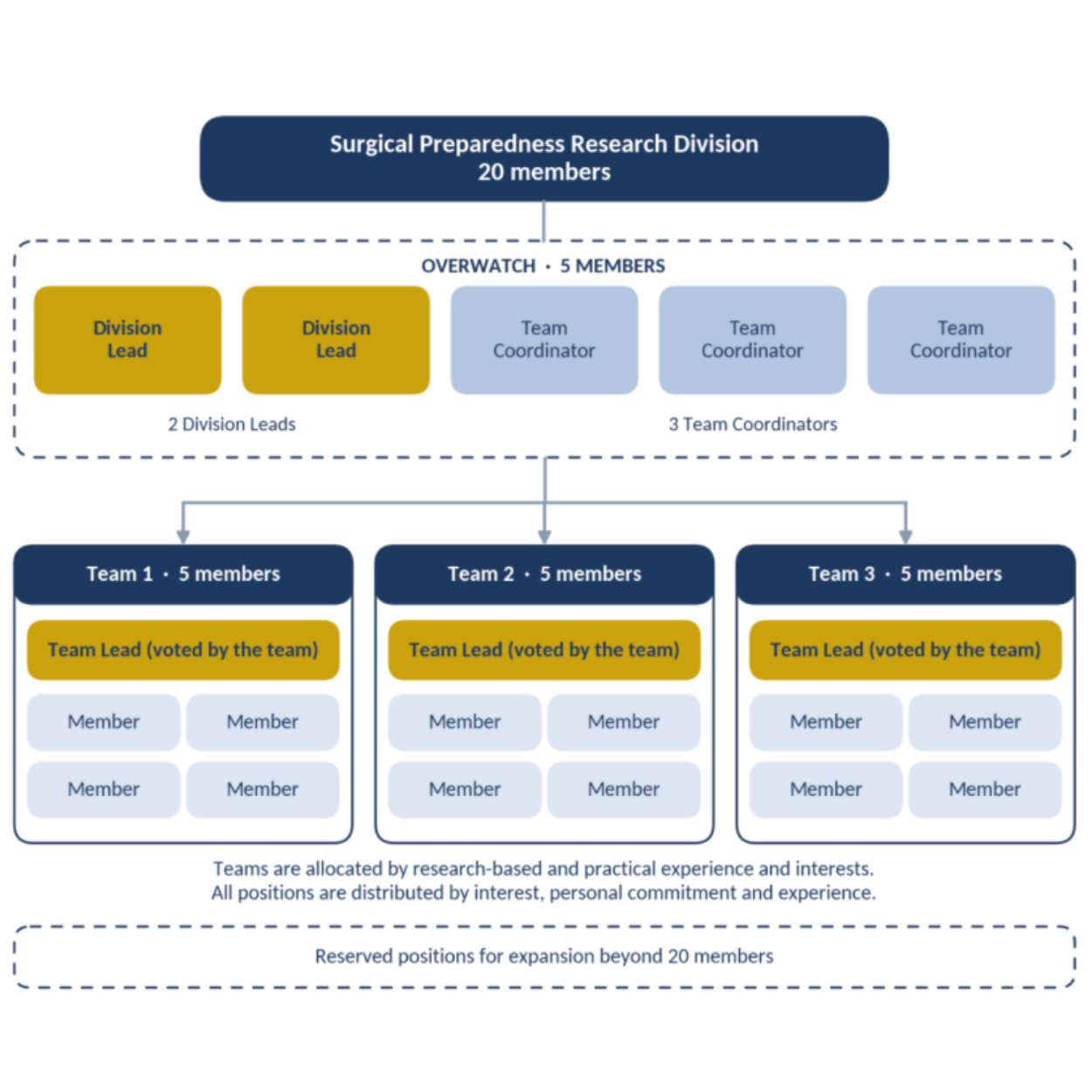
MCSPR is planned as a 20-member division, with reserved positions to accommodate expansion. Positions are distributed by interest, personal commitment, and experience.
MCSPR welcomes collaboration from:
Surgeons, anaesthetists, intensivists, emergency physicians, and theatre and perioperative staff
Disaster medicine, tactical medicine, and military medicine professionals
Public health, health-systems, and emergency planning researchers
Academic institutions and early-career researchers and students interested in surgical preparedness and counter-terrorism medicine
Get Involved!
Become a MSCPR Division member. Complete the Expression of Interest form today. Following our review, a member of our team will be in touch.