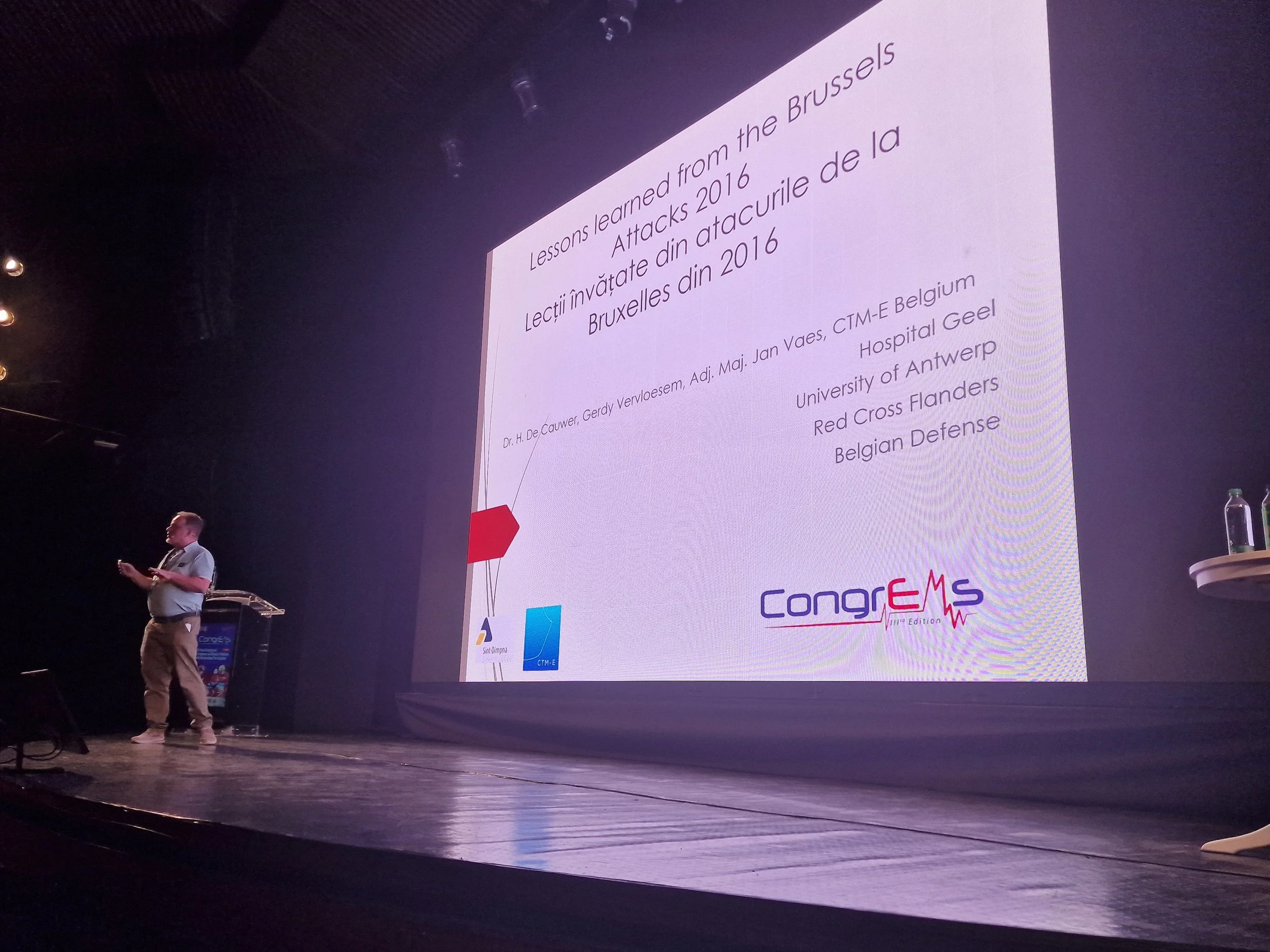
Dr Harald De Cauwer addresses the lessons from the 2016 attacks in Belgium in front of an international audience in Romania
©CTM-E
A decade after the devastating coordinated bombings at Brussels Airport and Maelbeek subway station, the critical medical and tactical takeaways from that day continue to redefine how Europe prepares for multi-site mass casualty incidents (MCIs).
Dr Harald De Cauwer, a leading neurologist and Counter-Terrorism Medicine Europe (CTM-E) Representative for Belgium, presented a comprehensive analysis of the 2016 attacks at the 2026 National Congress of Emergency and Disaster Medicine with International Participation, held in Târgu Mureş, Romania. His presentation focused on bridging the gaps between civilian medical emergency responses and the highly specialised field of Counter-Terrorism Medicine (CTM).
The work heavily highlights the collaborative field insights and operational data compiled alongside Gerdy Vervloesem and Adjunct Major Jan Vaes, whose firsthand expertise across civilian and military sectors has been instrumental in reshaping Belgium's unified research behind disaster response frameworks.
The presentation dissected the 2016 response into three crucial operational sectors that dictate survival outcomes in an active threat environment: scene safety and securitisation, streamlining inter-agency communication and integrated military and civilian medical evacuation.
The ongoing research presented by Dr. De Cauwer forms a cornerstone of CTM-E’s mission: translating painful historical lessons into standardised training, cross-border strategies, and specialised disaster planning across Europe.
As asymmetric threats evolve, integrating these hard-won operational pillars ensures that European medical first responders are better equipped, better coordinated, and safer on the front lines of future crises.